
Fort Bend ISD is starting the school year with seven fewer elementary schools. Many families
are making adjustments to new schools, new commutes, and new friends. However, there are
still questions about how those schools were selected, and what contributing factors led to the
closures to begin with, and what happens next? When you wonder how you got somewhere, the
old adage is to retrace your steps.
And the beginning of this school closure story starts with the 2023 school bond.
The 2023 bond program was voted on, and subsequently passed, in May 2023. It authorized a
bond of $1.26 Billion, one of the largest bonds passed in the district. The bond included three
propositions, with the primary proposition, Proposition A asking for over $1,180,830,000 for the
stated purpose of:
“REHABILITATING, RENOVATING, EXPANDING, IMPROVING AND EQUIPPING SCHOOL
BUILDINGS IN THE DISTRICT”
-Ballot language, 2023
The remaining bond fund proposals addressed school technology, and the building of a
Natatorium Facility.
Knowing school closures happened in 2026 it is easy to wonder what influence a bond passed
over two years prior could possibly have. But the 2023 bond has had a cascading effect on
distinct decisions and the impacted community that is worth examining.
How a school bond works
When voters approve a bond package, the district is not automatically granted that money.
Instead, this authorizes the board to borrow up to the approved amount, over time. It is a voter-
approved I.O.U that the district can collect on. Due to the size and complexity of this I.O.U,
borrowers, like FBISD, go through underwriters. The benefit of using one of these large firms is
often receiving a lower interest rate than one would get through more common channels, like
public facing banks and lenders.
Similar to a developer buying land, the underwriters sell the bond in much smaller amounts,
instead of selling the bond as a whole. This guarantees the underwriter a larger pool of buyers
who may not be able purchase a large complex bond (like the underwriters can) but are able to
purchase a smaller amount.
At this point, any interest accrued goes to the secondary investor, over the life of the bond until
it is repaid.
The bond & the closures
The 2023 bond language specifically targeted rehabbing and rehabilitating aging campuses, often referencing low FCI scores. Many voters expected those bond dollars to be used for their neighborhood schools. In fact, almost $14,000,000 has been spent on lifecycle maintenance, and structural projects spread between the seven closed schools, compared to the almost $20,000,000 that was promised. Meanwhile during the school closure FCI scores were used as a qualification for schools selected for closure. Now, many of the closed school communities continue paying on the district-wide bond even though their area schools have closed.
Additionally, the funds acquired from the bond were not enough to cover the scope of work originally proposed. This gap is largely attributed to COVID-era inflation.
This discrepancy also prompted an audit, handled by Gibson Consulting Group, who produced a Design and Construction Audit. In 2024 this same group was approved to generate a Cost Savings Audit in response to a projected future operating deficit. It was shared with the board in May 2025. This audit is the earliest documented instance we found of FBISD identifying closure of existing elementary schools as a potential cost-saving measure . The audit was specific in school closures being a potential savings scenario, not a recommendation.
As of March 31, 2026, FBISD’s $1.262 billion 2023 bond program had spent $620.2 million, with another $266.3 million encumbered and approximately $375.1 million remaining in the program.
Budget Shortfalls, How FBISD Stacks Up:
It is important to note that FBISD is not the only district facing budget and enrollment concerns.
Here is how some other schools have reacted.
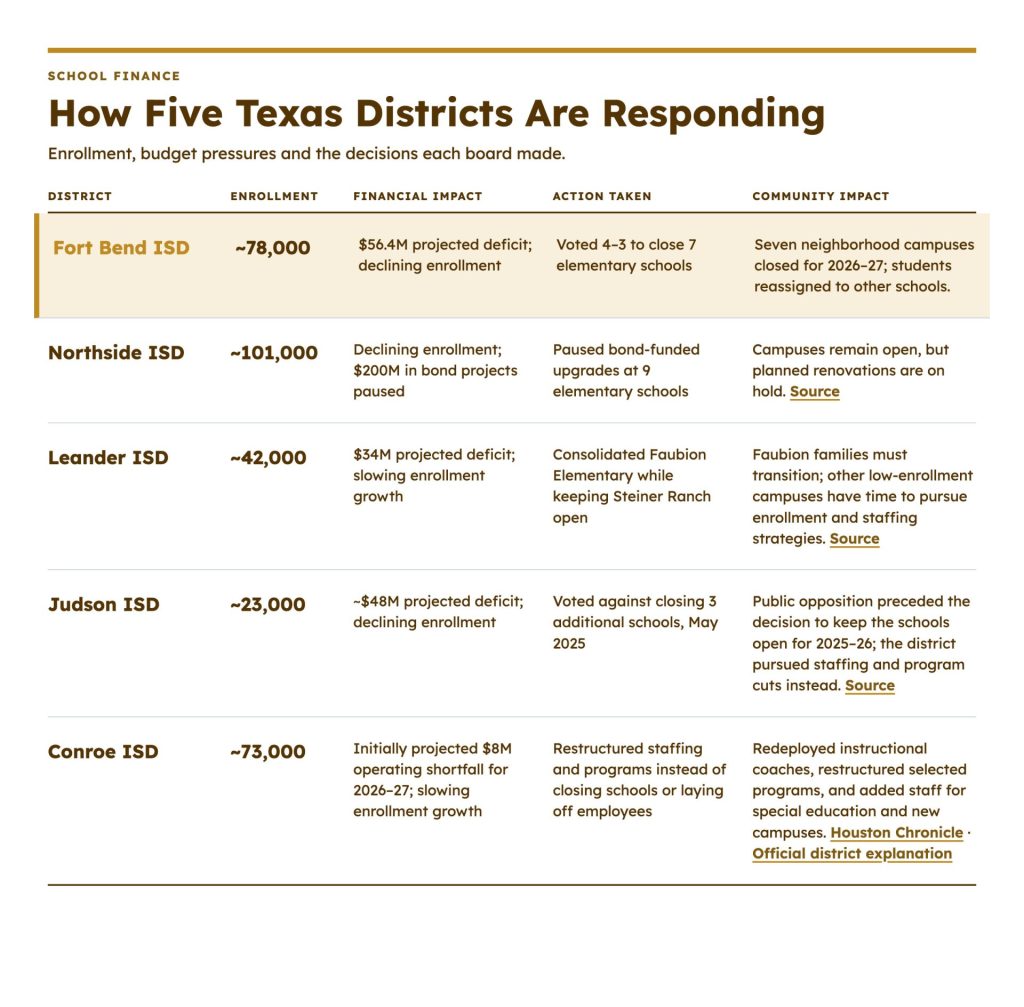
To be clear, Conroe ISD is a district experiencing growth, while Fort Bend ISD is seeing overall enrollment decline. Both are working to address targeted areas of growth, balanced with areas experiencing stabilization or underutilized campuses, while also working with finite funding, and every growing campus needs.
But FBISD is not alone in closing schools due to budget constraints, and enrollment and utilization concerns. Houston ISD closed 10 schools, Austin ISD closed 10 schools, and Fort Worth ISD approved a multi-year plan to phase out and close up to 18 campuses through 2029. School enrollment and funding continue to be a source of concern across the state. While many districts are facing similar problems it is important to remember that each district is handling unique problems and serving a diverse constituency, and that a good choice for one district may not be the right choice for another.
It is also important to note that FBISD has received recognition for its budget management and has an AA+ underlying credit rating. This rating indicates strong creditworthiness and signals to institutional investors that the district is a safe borrower. The AA+ rating reflects an assessment of Fort Bend ISD’s creditworthiness, including factors such as its financial management, local property wealth, and tax collection stability.
More than dollars and cents
While the 2023 bond was not directly responsible for the school closures, the facility improvements earmarked by those bond dollars were not enough to safeguard some neighborhood schools from closure, even as facility condition index (FCI) scores were frequently cited in decisions about which schools to close. Meanwhile, taxpayers throughout the district will continue paying toward repayment of the 2023 bond, including residents of communities whose neighborhood schools have now closed.
Questions about financial oversight predated the closure debate. Throughout the 2023 bond consideration, members of the Bond Oversight Committee raised questions about rising construction costs and the committee’s role in overseeing the program. In September 2025, the committee’s president publicly discussed the need for changes to its charter and oversight procedures.
Community opposition became visible during the closure process. At the February 23, 2026, School Board meeting, more than 80 parents spoke out against the proposed closures. Parents wore color-coded shirts, organized rallies, made signs, and continued to address trustees at board meetings, asking them to reconsider or pause the proposals.
The district emailed families its first notice on Dec. 15, 2025. The board voted to close schools on March 9, 2026, only 84 days later. During public comment speakers cited transportation safety, facility condition scores and doubts about how much the closures would ultimately save.
What now?
With the start of the 2026 school year, many students are seeing new faces, navigating new campuses, and making a fresh start, but old questions linger. By retracing the steps that led to the ultimate decision to close seven elementary schools, the hope is to better understand what decisions led FBISD to make such a significant decision, as well as having a better understanding of what happens next.
Future stories will further explore how the schools were selected for closure, a look at the budget implications, and as the 2026 school year commences, how those closures may be affecting enrollment.
Have a story for Kristyna? Email her at kloundy.fortbendfalcon@gmail.