
For years, Fort Bend County has been one of Texas’ premier political battlegrounds. Republicans once dominated county government before Democrats spent the better part of a decade building a governing majority through demographic change, candidate recruitment and an increase in turnout.
Now, after an unusual mid-decade redistricting effort, the battlefield itself has changed.
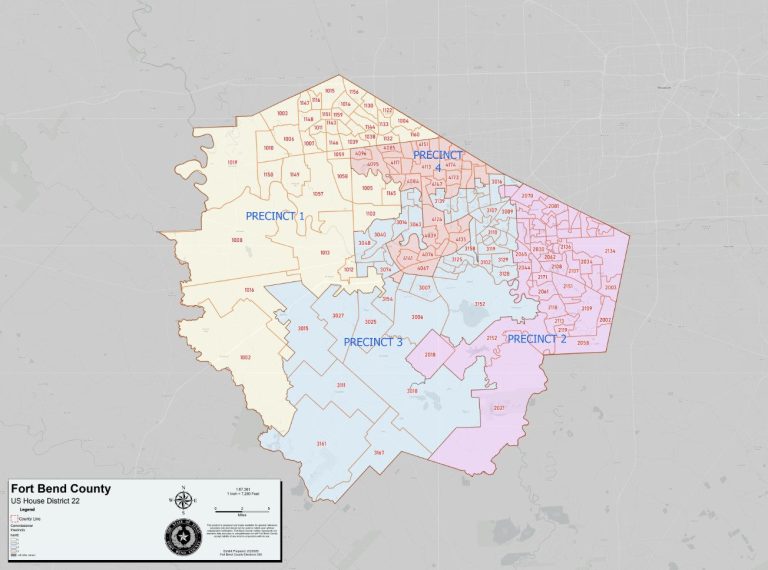
This November will be the first countywide election conducted under Fort Bend County’s new commissioner precinct map, offering the clearest test yet of whether Republicans successfully redrew the county’s political landscape or whether voters will redraw it again at the ballot box.
A Map Years in the Making
Fort Bend County’s new political map did not emerge from a regularly scheduled redistricting cycle. It became possible because one politician changed parties.
Following the 2020 Census, Fort Bend County’s Democratic-controlled Commissioners Court adopted new commissioner precinct maps that reshaped the court’s political balance. Then-County Judge KP George joined the Democratic majority in approving a map that created three Democratic-leaning commissioner precincts and one Republican-leaning precinct.
Among those most affected was Republican Commissioner Andy Meyers, whose home was briefly drawn outside the precinct he represented while his wife was battling a terminal illness. Meyers later established residency within Precinct 3 and remained eligible to serve, but he became one of the map’s most outspoken critics. He argued the districts had been drawn using improper racial considerations and failed to comply with state law.
For the next several years, Republicans lacked the votes on Commissioners Court to change the map.
That changed in 2025.
After being indicted on felony charges, KP George announced he was switching from the Democratic Party to the Republican Party. Overnight, control of Commissioners Court shifted from a 3-2 Democratic majority to a 3-2 Republican majority, giving Republicans the votes they had long lacked.
The new majority quickly launched a rare mid-decade redistricting effort, arguing that nearly one-fifth of the county’s election precincts no longer complied with state population requirements. Meyers became the leading advocate for redrawing the districts, describing the 2021 map as “flawed and unfair.”
The Republican majority ultimately approved new commissioner precinct boundaries, with Meyers saying the revised map corrected a process that “did not comply with state or federal law.”
Now, for the first time, Fort Bend voters will cast ballots under those new political boundaries.
This November’s election will be the first real test of whether the Republican majority merely redrew the map or fundamentally changed the county’s political future.
Four Precincts, Four Different Political Stories
Fort Bend County may vote as one county, but politically it behaves like four different ones.
The new map leaves Republicans with one reliably Republican precinct, Democrats with two Democratic-leaning precincts, and one precinct that could become increasingly competitive over time.
The judicial and commissioner races on this year’s ballot reflect those differences, with each precinct presenting its own political landscape and path to victory.
In this analysis we are focusing on precinct-wide races.
Precinct 1: The Republican Fortress
Partisan Lean
Republican: 59.8%
Democrat: 38.3%
If Republicans are going to win countywide offices, Precinct 1 must produce overwhelming margins.
The precinct remains the GOP’s strongest base, anchored by a largely White electorate while reflecting the broader demographic changes reshaping Fort Bend County, including growing Hispanic and Asian communities.
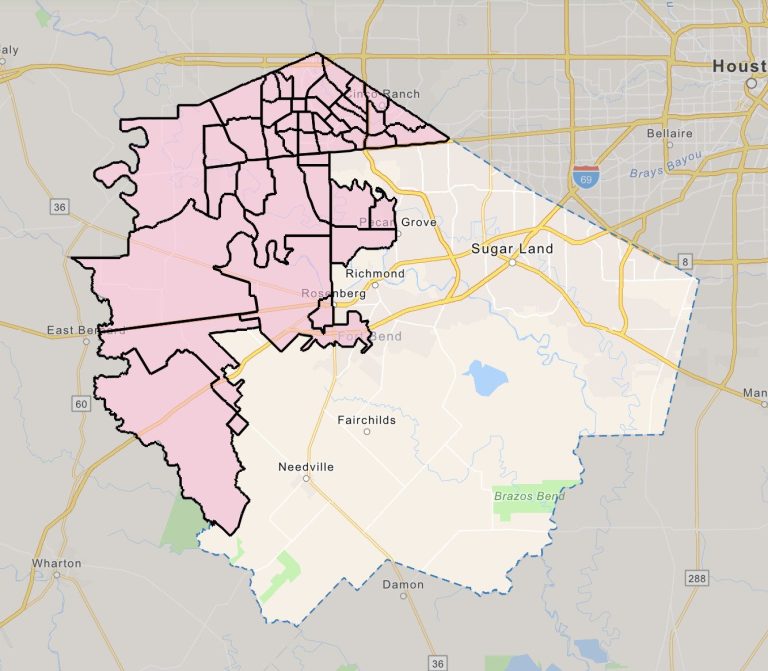
The marquee contests here are both Justice of the Peace races.
JP 1, Place 1: Incumbent Republican Kelly Crow faces Democrat Martin B. Sanchez.
JP 1, Place 2: Incumbent Republican Tricia Krenek faces Democrat Hortencia Sanchez.
An interesting subplot is that Martin Sanchez and Hortencia Sanchez, a mother and son, are running simultaneously for separate judicial seats.
Both Republican incumbents begin with favorable political terrain, but judicial races often receive less attention than countywide contests, making turnout particularly important.
Precinct 2: Democrats Defend Their Stronghold
Partisan Lean
Democrat: 67.96%
Republican: 30.21%
Precinct 2 remains the county’s Democratic anchor.
Commissioner Grady Prestage enters the race with both incumbency and a district that strongly favors Democrats. Republican Tony Aranda faces an uphill climb unless Republicans significantly outperform historical voting patterns.
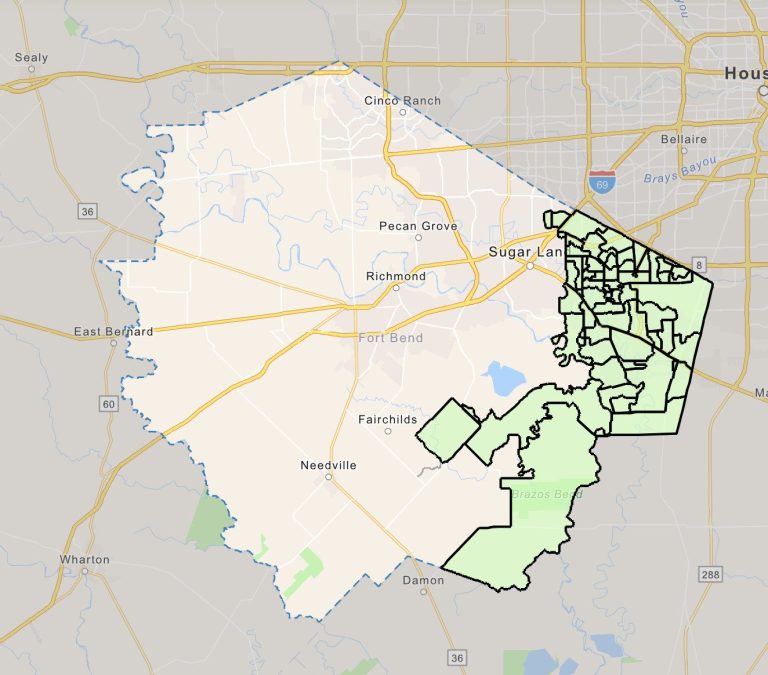
Justice of the Peace Roderick Garner likewise benefits from the Precinct 2’s Democratic advantage against Republican challenger Ninh Truong.
The larger question is less whether Democrats win here and more by how much. Large margins in Precinct 2 often offset Republican advantages elsewhere in the county.
Precinct 3: The County’s Most Competitive Precinct
Partisan Lean
Republican: 53.62%
Democrat: 44.15%
Precinct 3 may become the county’s most closely watched judicial battleground.
In Place 1, Republican William Ferguson brings substantial name recognition after years of public service. But Democrat Sonia Rash is the incumbent, giving voters a choice between familiarity with Ferguson’s name and Rash’s record on the bench and her presence in the community.
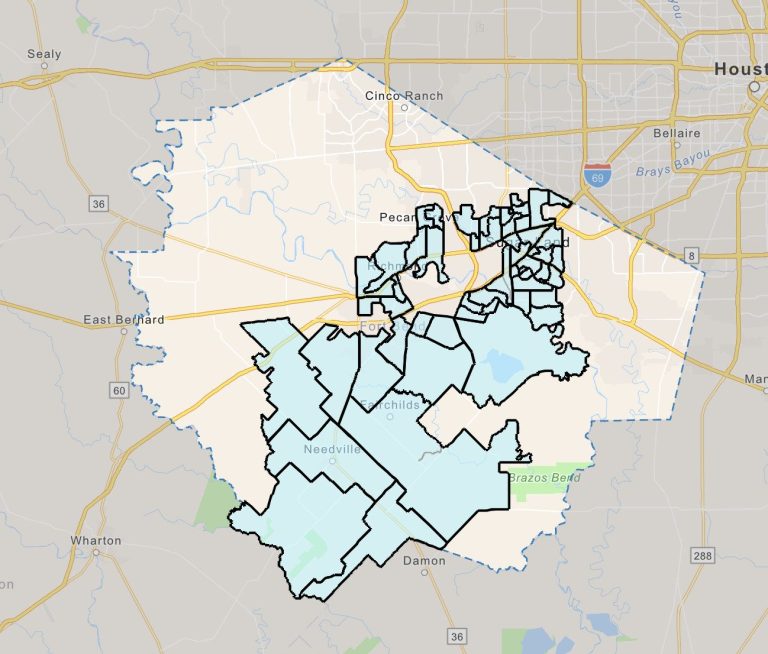
Place 2 features perhaps the most intriguing race on the ballot.
Republican Ken Cannata currently serves after being appointed by Commissioners Court to the newly created court. Unlike many incumbents, he has never faced voters for this office.
Democrat Rachelle Carter, an associate municipal judge and longtime attorney, enters the race seeking to become the first judge elected to the new court by the public.
Although Judge Ken Cannata currently occupies the bench through appointment, November will give voters their first opportunity to decide who should serve on the newly created court.
Precinct 4: A Democratic Advantage, But No Incumbent
Partisan Lean:
Democrat: 58.24%
Republican: 39.09%
Precinct 4 enters the election with a clear Democratic advantage, but unlike many races on the ballot, there is no incumbent.
Commissioner Dexter McCoy is vacating the seat to run for County Judge, leaving Republicans’ Ken Mathews and Democrats’ April Jones competing for an open commissioner’s seat.
Open-seat elections often attract more attention because voters are choosing a new representative rather than deciding whether to return an incumbent to office. While the district favors Democrats on paper, Republicans will likely view the absence of an incumbent as an opportunity to compete in a race that otherwise begins with a Democratic advantage.
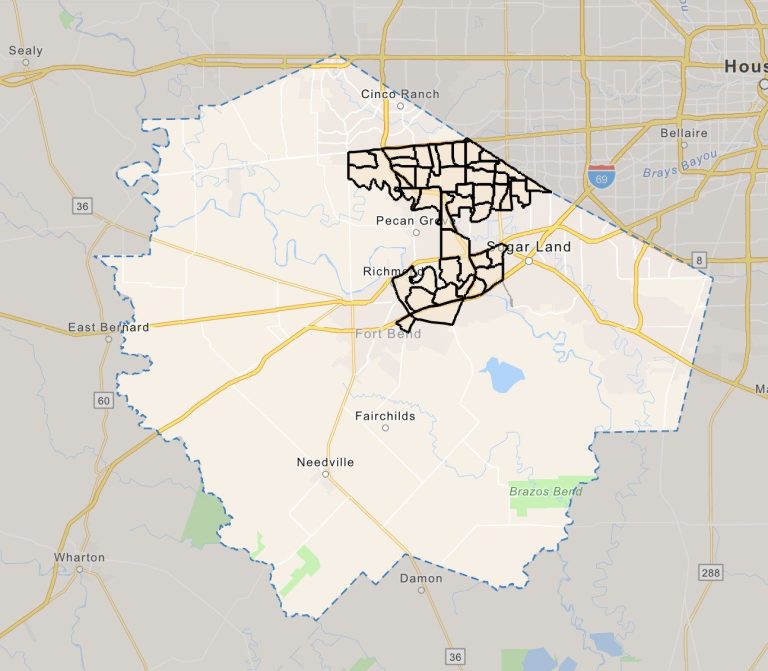
And Then There Is Our Diversity…
While Fort Bend County is often recognized for its diversity, that diversity is not evenly distributed across the county.
Each commissioner precinct has its own demographic profile. Some precincts have larger Black populations, others have larger Asian communities, while Hispanic voters make up a significant share of the electorate across all four precincts. Those differences help shape the political coalitions candidates build and the issues that often resonate with voters.
Understanding Fort Bend’s elections means looking beyond party labels. The county’s political landscape is influenced not only by geography, but also by the unique demographic makeup of each precinct. Candidates that build coalition support by showing up in these communities can cross party line barriers.
Precinct 1: Republican Strength Amid a Changing Electorate
White: 47.63%
Minority: 52.37%
Hispanic: 22.46%
Black: 9.27%
Asian: 19.14%
Precinct 1 is the county’s most Republican precinct and its whitest, but the numbers illustrate how Fort Bend Republicans have built support beyond their traditional electorate. While white voters remain the largest single demographic group, nearly one in five voting-age residents is Asian and more than one in five is Hispanic, making coalition-building essential for Republican candidates.
Precinct 2: The Democratic Base
White: 18.19%
Minority: 81.81%
Hispanic: 22.41%
Black: 40.51%
Asian: 18.85%
Precinct 2 has the county’s largest Black voting-age population, with Black residents accounting for more than 40% of the electorate. Combined with sizable Hispanic and Asian communities, it has become the Democratic Party’s strongest precinct. Democratic candidates here typically focus less on persuasion and more on maintaining strong turnout among an established coalition.
Precinct 3: The Swing Precinct
White: 39.22%
Minority: 60.78%
Hispanic: 23.39%
Black: 12.07%
Asian: 24.26%
Politically, Precinct 3 occupies the space between Fort Bend’s Republican and Democratic strongholds. Its demographic makeup reflects that position, with White voters representing the largest share of the electorate but substantial Hispanic and Asian populations making coalition-building essential. Candidates who succeed here are often those who can broaden their appeal across multiple communities rather than rely on a single base.
Precinct 4: Fort Bend’s Most Diverse Precinct
White: 21.97%
Minority: 78.03%
Hispanic: 22.53%
Black: 23.67%
Asian: 31.59%
Precinct 4 is arguably the county’s most demographically diverse precinct. Asian residents make up nearly one-third of the voting-age population, the highest share in Fort Bend County, while Black and Hispanic voters each account for roughly one-quarter of the electorate. The result is a true coalition precinct, where no single community holds a majority and successful candidates must connect with a broad cross-section of voters.
What to Watch
Fort Bend County is often described as one of the nation’s most diverse counties. Increasingly, it is also one of Texas’ most politically complex.
The county no longer fits neatly into red or blue categories.
Republicans have strengthened their position through redistricting.
Democrats continue to rely on diverse suburban coalitions and turnout in their strongest precincts.
The maps have changed.
Now we will learn whether the voters change with them.
The election will also be a test of whether Fort Bend voters are paying attention to a year of political upheaval, from the removal of former County Judge KP George following his legal troubles and racial-bating campaign tactics, to the appointment of Interim County Judge Daniel Wong, and the ongoing tensions between Wong and Commissioner Dexter McCoy that have reshaped the conversation inside and outside of Commissioners Court.
Will the controversy drive voters to the polls, or will it fade into the background for residents focused on everyday issues? Can Democrats build on their gains among a changing electorate? Can Republicans maintain their strength and expand their coalition?
In the end, the outcome may come down to something less dramatic than headlines: organization, turnout and whether either party can convince voters that this election is worth showing up for. Also, are the candidates raising the money to get their message out there? We’ll know in 105 days.