
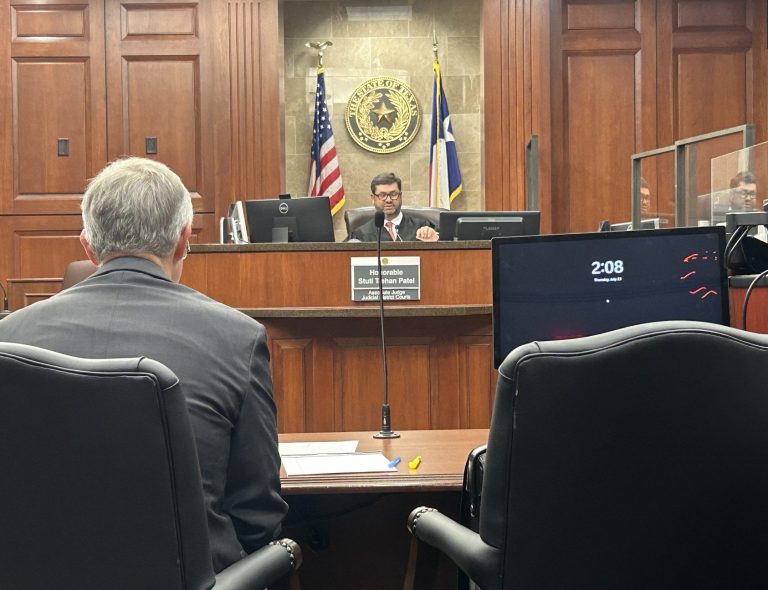
RICHMOND, TX – A visiting Galveston County judge heard arguments Thursday over whether a previously dismissed lawsuit involving former Fort Bend County Judge KP George should be clarified to state that an order appointing Daniel Wong as interim county judge was automatically vacated when the case was nonsuited.
The hearing in Roberts v. George centered on whether the court still has jurisdiction to clarify the effect of its own orders after plaintiff Sarah Roberts dismissed her case, including the impact of an earlier order issued by visiting Galveston County Judge Jeth Jones appointing Wong as interim county judge under Chapter 87 of the Texas Local Government Code.
Representing Roberts, attorney Dylan Russell argued the court should issue an amended nonsuit order confirming that the temporary appointment order was automatically dissolved when the underlying case ended.
Representing intervenor Daniel Wong, attorney Chris Hilton argued the court no longer has authority to act because the case is closed, no live controversy remains, and any ruling would amount to an advisory opinion in an ongoing political dispute.
Judge Jones took the matter under advisement and said he would issue a ruling as soon as possible.
Roberts Seeks Clarification of Nonsuit Order
Roberts originally filed the lawsuit seeking the removal of KP George from office. During the litigation, visiting Galveston County Judge Jeth Jones issued an order under Chapter 87 of the Texas Local Government Code appointing Daniel Wong as interim county judge.
After the case proceeded through the removal process, Roberts nonsuited the lawsuit. Her attorney argued the temporary appointment order was automatically vacated by operation of law when the underlying case was dismissed and asked the court to clarify that effect through an amended order.
Russell told the court the request was not an attempt to determine Wong’s ultimate legal status, which is being addressed in a separate proceeding, but rather a request for the court to explain the legal consequence of its own nonsuit order.
He compared the temporary appointment to a temporary injunction, arguing that established precedent holds such orders dissolve automatically when the underlying case is dismissed.
Russell cited General Land Office v. Oxy USA Inc. as support for the argument that no additional judicial action is required to terminate a temporary order once the underlying proceeding ends.

Wong Argues Case Is Closed
Hilton, representing Wong, argued the court no longer has jurisdiction because the original lawsuit has ended and there is no remaining dispute between the original parties.
He characterized Roberts’ request as an attempt to obtain an advisory opinion that could influence a separate legal battle over Wong’s authority and the upcoming November election.
Hilton argued that questions regarding Wong’s authority to continue serving as interim county judge belong in a separate quo warranto proceeding pending in the 400th District Court.
Any action by the court regarding Wong’s appointment, he argued, would be an improper collateral attack on subsequent actions taken by Fort Bend Commissioners Court, which accepted Wong’s oath of office.
Hilton argued the court should deny the pending motions and allow the matter to proceed in the appropriate forum.

Parties Clash Over Intervention and TCPA Motion
The hearing also addressed whether Wong had the right to intervene in the dismissed case.
Russell argued Wong’s intervention should be dismissed because a party generally cannot intervene after a final judgment has been entered. He cited Texas Right to Life v. Van Stean in arguing that standing and jurisdiction must be resolved before the court considers the merits of Wong’s participation.
Russell said if Wong lacked standing, the court should strike the intervention and consider Roberts’ pending Texas Citizens Participation Act (TCPA) motion separately.
Hilton countered that Wong’s intervention was limited to protecting his interests in motions directly affecting his appointment. He argued the TCPA does not apply because Roberts did not bring a “legal action” against Wong.
He maintained that if Roberts has standing to pursue additional relief after dismissal, Wong has standing to respond.
Procedural Motions Remain Pending
The court also heard discussion about several related procedural matters, including a possible severance of the intervention and a motion to modify the judgment.
Russell argued severing Wong’s intervention would create a cleaner record for any future appeal and avoid combining a post-judgment dispute with a closed case.
Hilton opposed severance, arguing there were no remaining claims to separate.
A separate motion filed by Roberts challenging the case based on sovereign immunity was also discussed but was not set for hearing. The parties agreed it could be addressed at a later date.
George No Longer a Party to Case
Attorney Jared Woodfill, representing George, confirmed his client is no longer an active party in the case.
Woodfill told the court George remains suspended from office under a separate criminal court order while his appeal continues.
What Happens Next
As the hearing concluded, Jones noted that the court was dealing with a “very complex and complicated” matter before taking the arguments under advisement.
Roberts’ attorney, Dylan Russell, told the Fort Bend Falcon that Roberts’ legal team is awaiting the court’s decision.
“We appreciated the Court’s careful attention to the issues being argued,” Russell said. “We look forward to a prompt ruling so any next steps can be taken, should they be necessary.”
Separately, questions regarding Wong’s authority to continue serving as interim county judge are also being addressed through a quo warranto proceeding filed in the 400th District Court. Fort Bend County Attorney Bridgette Smith-Lawson filed the action more than two weeks ago, but no hearing date has been set.
During Thursday’s hearing, Wong’s attorney, Chris Hilton, argued that the separate quo warranto proceeding is the appropriate venue for resolving questions about Wong’s authority and that the current case should not be used to decide those issues.
The legal uncertainty has continued to affect Fort Bend Commissioners Court. Commissioners Grady Prestage and Dexter McCoy have said they do not plan to return to court meetings until the dispute over the county judge’s authority is resolved.
Despite their absence, the three Republican members of Commissioners Court have continued to meet and conduct county business.