
FORT BEND COUNTY — What began as a dispute over redistricting has evolved into a broader political and legal struggle over who controls the legal affairs of Fort Bend County.
County Attorney Bridgette Smith-Lawson’s decision this week to file a quo warranto action challenging Interim County Judge Daniel Wong’s authority to hold office is the latest chapter in a fight that stretches back to the county’s contentious 2021 redistricting process and intensified after Republicans gained control of Commissioners Court in 2025.
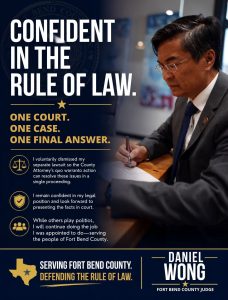
On Tuesday, Wong voluntarily dismissed his own lawsuit seeking judicial clarification of his authority, saying Smith-Lawson’s filing allows both issues to be resolved in a single proceeding.
“Today, the Fort Bend County Attorney chose to file a quo warranto action after I sought judicial clarification of my lawful authority to serve as your County Judge,” Wong said in a public statement.
“In response, I voluntarily dismissed my separate lawsuit because these issues can now be resolved in a single proceeding before the court. This is not a retreat—it is the most direct path to a final answer under the rule of law.”

The opinion also emphasized that Commissioners Court and independently elected county officials each possess separate statutory authority and that neither may improperly interfere with the other’s legal responsibilities.
While the opinion addressed the narrow issue of election precinct redistricting, it marked the beginning of a broader debate over the role of the County Attorney’s Office in county government.
Outside counsel takes center stage
Since Republicans gained control of Commissioners Court, outside attorneys have assumed an increasingly prominent role in county government.
In 2025, Commissioners Court voted 3-2 to hire the J. Grady Randle of Randle Law Office to evaluate the authority of Smith-Lawson’s office. Democrats opposed the move, arguing the county was paying private attorneys to examine the authority of an independently elected official despite already maintaining a County Attorney’s Office.
Attorney J. Grady Randle has since become a central figure in several of the county’s highest-profile legal disputes.
During recent debate over revisions to Commissioners Court’s Rules of Procedure and a new artificial intelligence policy, Wong repeatedly cited Randle’s legal advice while defending the proposals.
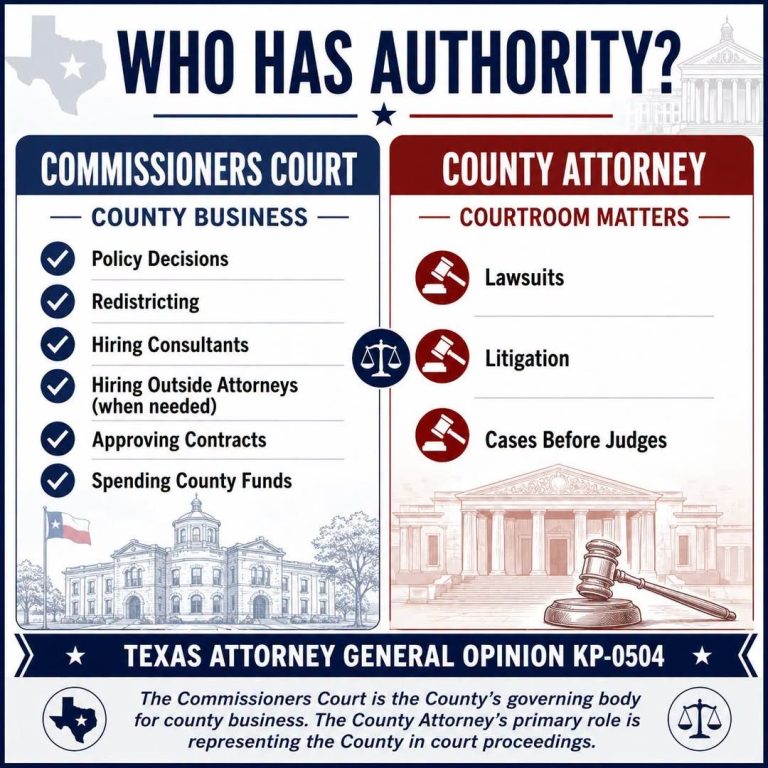
At the same time, Republicans have increasingly argued that Commissioners Court—not the County Attorney—holds primary authority over many county matters.
A graphic circulated by local Republicans titled “Who Has Authority?” states that Commissioners Court controls county business, including policy decisions, contracts, consultants, outside legal counsel, redistricting and county spending, while characterizing the County Attorney’s primary responsibilities as lawsuits and courtroom litigation.
Wong said he remains confident in his legal position and accused unnamed political opponents of “playing politics,” adding that he would continue serving the county while the courts resolve the matter.
For Smith-Lawson, however, the lawsuit represents something much larger.
“It is an effort to coerce, bully, and intimidate me from doing my duty as Fort Bend County Attorney,” she said in a statement announcing the quo warranto action.
“As Fort Bend County Attorney, I am acting squarely within my statutory duty to represent the State in District Court and to bring quo warranto proceedings when someone is alleged to be unlawfully holding a public office. This is an institutional responsibility assigned to my office by the Texas Constitution and Legislature; it is not a political or partisan decision.”
A fight years in the making
The legal battle over Wong’s appointment did not begin with Wong.
Its roots trace back to 2021, when Fort Bend County’s Democratic-controlled Commissioners Court adopted new commissioner precinct maps following the 2020 Census.
At the time, County Judge KP George was a Democrat and joined the Democratic majority in approving a map that reshaped the political makeup of Commissioners Court. The new districts created three Democratic-leaning commissioner precincts and one Republican-leaning precinct.
Among those affected was Republican Precinct 3 Commissioner Andy Meyers, whose home was briefly drawn outside the precinct he represented while his wife was battling a terminal illness. Meyers later established residency within Precinct 3 and remained eligible to serve, but he became one of the map’s most outspoken critics, arguing the districts had been drawn using improper racial considerations and failed to comply with state law.
That disagreement would shape county politics for years.
The political landscape shifted dramatically in 2025 when George switched to the Republican Party following a felony indictment, giving Republicans a 3-2 majority on Commissioners Court.
With control of the court, Republicans launched a rare mid-decade redistricting effort, arguing that roughly one-fifth of the county’s election precincts no longer complied with state population requirements. Meyers emerged as the leading advocate for redrawing the maps, calling the 2021 process “flawed and unfair.”
Following adoption of the new maps, Meyers said the Republican majority had corrected what he described as a process that “did not comply with state or federal law.”
The Attorney General opinion
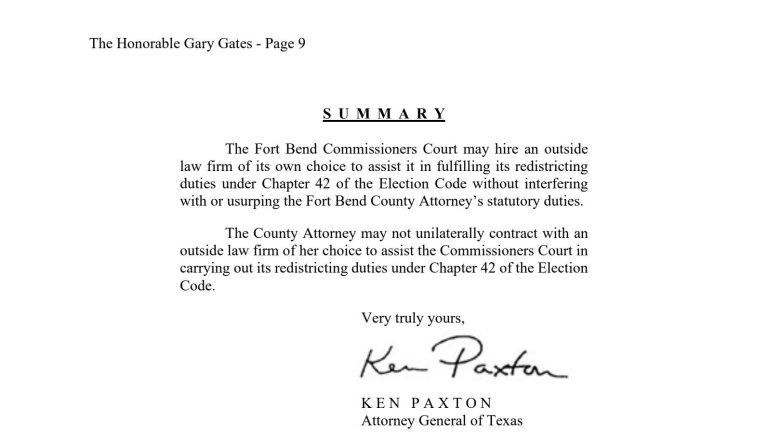
As the mid-decade redistricting effort got underway, State Rep. Gary Gates sought an opinion from the Texas Attorney General asking whether Commissioners Court had the authority to hire outside legal counsel to assist with election precinct redistricting instead of relying on the elected County Attorney’s Office.
Attorney General Opinion KP-0504 concluded that Commissioners Court could hire outside counsel for that limited purpose because redistricting under Chapter 42 of the Election Code is a legislative function rather than litigation pending before a court.
For Smith-Lawson, the message reflects a broader effort to diminish an office created by state law and filled by county voters.
She says her office employs 22 attorneys capable of handling the county’s legal work and has questioned why taxpayers should fund outside lawyers when the county already maintains a fully staffed legal department.
“I got sued for doing my job.”
Speaking publicly after Wong filed suit against her, Smith-Lawson said she was being punished for carrying out the responsibilities voters elected her to perform.
“I got sued for doing my job,” she said.
“I had two options: shut up, do nothing, turn a blind eye, or speak up. And essentially, I took the part that you all knew I would took.”
She said she believes the law governing Wong’s appointment is clear.
“The law in this matter is settled. There is no dispute about this.”
Smith-Lawson urged residents to read the court filings themselves and discuss them with neighbors, churches and civic groups.
“You all elected me to be here and to do the job,” she said.
She also described conditions inside her office.
“It is 88 degrees in my office,” Smith-Lawson said. “I’m sweating. It’s the seventh week without AC. I am doing the work.”
The Fort Bend Falcon has submitted a Texas Public Information Act request seeking maintenance records and communications regarding the reported seven-week air conditioning outage in the County Attorney’s Office.
Elected without opposition
Despite the ongoing political disputes, Smith-Lawson has faced little opposition at the ballot box.
She won reelection in 2024 without opposition in either the Democratic primary or general election.
Her last contested race came in 2020, when she defeated Republican Steve Rogers with 177,836 votes, or 52.6%, to Rogers’ 160,110 votes, or 47.4%.
Today, rather than defending her office before voters, Smith-Lawson is defending its authority in court.
The quo warranto proceeding will determine whether Wong may lawfully continue serving as county judge. But the litigation also represents the latest chapter in a years-long struggle over the balance of power in Fort Bend County government, a conflict that has stretched from the 2021 redistricting battle, through the Republican-led mid-decade redraw in 2025, to the courthouse today.